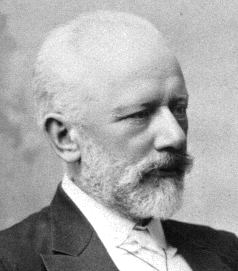
Letter 2244
| Date | 21 March/2 April 1883 |
|---|---|
| Addressed to | Nadezhda von Meck |
| Where written | Paris |
| Language | Russian |
| Autograph Location | Klin (Russia): Tchaikovsky State Memorial Musical Museum-Reserve (a3, No. 833) |
| Publication | П. И. Чайковский. Переписка с Н. Ф. фон-Мекк, том 3 (1936), p. 165–166 П. И. Чайковский. Полное собрание сочинений, том XII (1970), p. 91–92 |
| Notes | Original incorrectly dated "20 March/2 April" |
Text and Translation
| Russian text (original) |
English translation By Brett Langston |
Вчера получил я письмо Ваше со вложением перевода, милый, дорогой друг! Благодарю Вас от глубины души за великое одолжение, а также за все сочувственные слова Ваши ко мне, проникнутые такой бесконечной добротой и тёплым дружеским чувством, что, читая их, я был до слез тронут. Простите, ради Бога, если первою частью своего прошлого письма я навёл хоть мгновенную тень неудовольствия на себя. Я колебался не потому, что совестился, перед Вами. Я знаю, что всякое обращение моё к Вам встретит всегда сочувствие и готовность отозваться на него, — но мне совестно, так сказать, перед самим собою и досадно, что, получая такие обильные средства для жизни, — я всё-таки по временам выхожу из своего бюджета и не умею сводить концы с концами. А главное, мне известно, как много у Вас теперь забот и тревог, и так не хотелось хоть на минуту увеличивать своей просьбой сумму забот этих. Убедительно прошу Вас раз навсегда быть совершенно покойно и насчёт Анны. Ничего того, чего Вы страшитесь за неё, не может быть никоим образом. Это натура, не имеющая ничего общего ни с болезненной эксцентричностью старшей сестры, ни с взбалмошностью и неровностью Тасиного характера. Анна есть прямая противоположность Тани. Насколько последняя всегда тяготилась течением ровной и простой деревенской жизни и вечно заботилась о том, как бы убить время, настолько Анна дорожит каждым мгновением дня и всегда сокрушается, что времени так мало для всего, что она хотела бы сделать. Деятельность её необыкновенно сильна и разнообразна. Она всё хочет знать, всё уметь, и вместе с тем у неё есть потребность быть полезной, вследствие чего она не знает скуки и никакой надобности в наркотиках никогда испытывать не будет. Кроме того, пример Тани был для неё, при её уме и здравом смысле, отрицательно полезен. Она часто говорит, что Таня как будто нарочно старается показать ей наглядно, чего не следует делать и чего следует избегать девушке, желающей быть здоровой и счастливой. Это вообще здоровая, цельная натура, имеющая много родственных черт с Вашим сыном Колей, и сочетание этих двух душ будет очень отрадным явлением. Здоровье Тани в последние дни нехорошо. Она так слаба, что бывают часы дня, когда не в силах говорить и глаза отказываются видеть. Последнее явление пугает меня. Доктор объясняет это уменьшением морфинной дозы и обещается, что всё пойдёт лучше через несколько времени. Я кончил сочинение кантаты и марша и принялся за оркестровку. Нередко работа утомляет меня до крайности, — но на здоровье жаловаться не могу. В последнем письме Вашем почерк руки твёрдый; мне хочется думать, что Вам теперь лучше, что Вы чувствуете себя крепче и бодрее, тогда как почерк предыдущего письма выражал как бы сильную усталость. Дай Бог, чтобы так было. Ещё раз благодарю Вас, дорогая моя! Ваш до гроба, П. Чайковский |
I received your letter yesterday with the transfer enclosed, my dear, good friend! I thank you from the bottom of my heart for this magnificent kindness, and also for all your sympathetic words to me, filled with such boundlessly kind and warm friendly feelings that I was moved to tears reading them. Forgive me, for God's sake, if the first part of my last letter cast even a momentary shadow of displeasure upon myself. I hesitated not because I was ashamed of myself, but rather before you. I know that any sort of appeal I make to you will always be met with sympathy and a willingness to respond to it — but I am ashamed, so to speak, before myself, and annoyed that, receiving such abundant means for a lifetime, I still exceed my budget from time to time, and cannot make ends meet. But above all, I know how many worries and concerns you now have, and I so did not want to increase the amount of these concerns for even a moment with my request. I earnestly request you once and for all to be completely at peace regarding Anna. None of your fears for her can possibly come to pass. Her nature has nothing in common with either her older sister's morbid eccentricity, or Tasya's capricious and uneven temperament. Anna is the exact opposite of Tanya. To the extent that the latter has always been burdened by the routine of simple country life, and has always been concerned with how to kill time, Anna values every moment of the day, and is always aggrieved by the fact that there is so little time for everything she would wish to do. Her activities are exceptionally strong and varied. She wants to know everything, to be able to do everything, and at the same time she has a need to be useful, as a result of which she does not know boredom, and will never experience the need for narcotics. Moreover, Tanya's example has been negatively beneficial for her, given her intelligence and common sense. She often says that Tanya seems to be deliberately trying to show here clearly what she ought not to do, and what a girl who wants to be healthy and happy ought to avoid. This is generally a healthy, integral nature, sharing many similar traits with your son Kolya, and the combination of these two souls will be a most gratifying phenomenon. Tanya's health ahs been poor recently. She is so weak that there are times of day when she cannot speak, and her eyes refuse to see. The latter phenomenon alarms me. The doctor attributes it to a reduction in the dose of morphine, and promises that everything will improve in a little while. I have finished composing the cantata and march, and have set about orchestrating them. The work not infrequently tires me to the extreme, but I cannot complain about my health. Your handwriting in your last letter is steadier; I would like to think that you are now better, that you feel stronger and more cheerful in yourself, whereas the handwriting of the previous letter seemed to express severe fatigue. God grant that it may be so. Thank you once again, my dear! Yours unto the grave, P. Tchaikovsky |